

The Charterhouse archive is stored and made accessible to the public at The London Archives in Islington. It covers an impressive 123 metres of shelf space and contains the charity’s records from 1611 onwards, along with a few documents that pre-date the charity including the personal papers of the founder, Thomas Sutton.
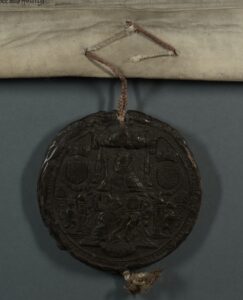
One of the highlights of the charity’s archive is the original charter giving royal assent to the foundation: the Letters Patent issued under the Great Seal of James I on 22 June 1611. One of several royal charters in the archive, it is arguably the most important but, until recently, has not been accessible.
For centuries, the three large parchment sheets of the charter have been kept rolled up in a scroll case, with the pendant seal attached by a cord hanging in a small bag. Any attempt to unroll the charter to read it was considered likely to damage the parchment, and it was labelled ‘unfit’ for general access.
Bringing the Charter Back to Life
Thanks to a grant from the National Manuscripts Conservation Trust and the expertise of The London Archives’ conservation studio, the charter has been conserved and made accessible for the first time in centuries.
The long conservation process involved flattening and cleaning the parchment membranes and seal, which had accumulated hundreds of years of dirt. Flattening the parchment was carried out using an ultrasonic humidifier, which produces a fine cold mist helping to prevent the parchment cracking, staining or distorting. Each of the three membranes were humidified one at a time and then air-dried, using magnets to hold the parchment down. They were then cleaned using a sponge and a soft brush, taking care to get into heavy creases in the parchment without removing or damaging any ink.
The conserved document is not perfectly flat, as over-flattening could cause damage. A bespoke storage box was made to house the parchment with a niche to support the pendant seal. The charter was also photographed as part of the process, creating a high-resolution digital copy, which means we are finally able to read it without handling and risking damage to the fragile parchment.
A Royal Seal of Approval
The document itself is a fine example of a 17th-century royal charter, written in elegant charter hand throughout. It features a portrait of the king framed in the initial ‘J’, and a well-preserved Great Seal depicting James I enthroned.
The contents of the charter set out Thomas Sutton’s new foundation, giving royal approval to the “erection and establishment of an Hospitall and a free Grammar Schoole” in the “house called the late dissolved Charterhouse besides Smithfield”. The charity was formally named in this document, which specifies that:
“the saide hospital shall forever hereafter be incorporated, named and called The Hospital of King James founded in Charterhouse within the Countie of Middlesex at the humble petition and only cost and charge of Thomas Sutton Esquire”
An Exchange of Estates
The story behind the charter gives a fascinating insight into the creation and early days of the charity. Sutton had originally intended for his ‘Hospital’ and grammar school to be built in his manor of Hallingbury Bouchers in Essex—one of several places in the east of England in his extensive property portfolio. He got so far as having the new Essex foundation confirmed by an Act of Parliament in 1610. However, the following year he changed his mind and set his eyes on the Charterhouse as the site for his charity instead.
The Charterhouse was owned by Thomas Howard, Earl of Suffolk, the second son of the 4th Duke of Norfolk, who had been executed as a traitor for his involvement in the Ridolfi Plot to overthrow Elizabeth I. Suffolk was looking to expand his country house, Audley End, near Saffron Walden in Essex, and to achieve this, he needed money and land.
Thomas Sutton had plenty of both and agreed a deal to their mutual advantage: he would pay £13,000 for the Charterhouse and throw into the bargain his manors of Hadstock and Littlebury, which neighboured Audley End. They set to work: Suffolk rebuilt Audley End to become one of the greatest country houses in England, and Sutton ordered the conversion of the Charterhouse into his almshouse and school.
A Contested Legacy
The change to Thomas Sutton’s plan required an amendment to the law, but it was too late to be confirmed by the six-year-long first parliament of King James I, which was finally dissolved in February 1611. The deal was done in stages over the course of that year and confirmed by Letters Patent in June.
Thomas Sutton died in December 1611, before the Charterhouse was ready for the first beneficiaries of his legacy. His will, which left his fortune to the charity, was contested. Another charter in the collection records the 1613 court ruling against Sutton’s nephew, Simon Baxter, who wanted more than the £300 left to him in the will.
However, the charity prevailed, and the first Brothers and scholars of the Charterhouse moved in the following year.
James Spellane, Visitor Engagement Manager
Letters Patent of James I for the foundation of Sutton’s Hospital (detail) and Pendant seal. Courtesy of The London Archives.