

How the evolution of the Charterhouse architecture reveals the changing relationship between monks, the local community, and women.
When discussing the London Charterhouse, we often focus on when it reached its fully developed state. After the boundary wall was built, the cells completed, and the monastery was filled with the bustle of habited monks, the site appears fixed. Yet in the early years of the House’s life, things were far more fluid. This was a period in which the community was still finding its footing, buildings were incomplete, and the foundation itself was developing. Between 1371 and 1405, the layout of the Charterhouse looked wholly different from the orderly system of buildings depicted in the Charterhouse Water Maps (Fig, 1). In many ways it resembled what we might consider as open planned – and this blog explores why.
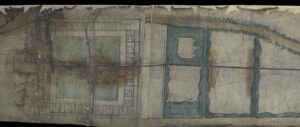
Figure 1: Water Map 1 c.1450.
As the well-known story goes, the London Charterhouse was founded in 1371 by Sir Walter Manny and the Bishop of London as a monastery of the Carthusian Order. However, it’s construction was somewhat piecemeal and took place as money and time allowed. The twenty-five cells for the monks were not completed until well into the fifteenth century, and the Little Cloister was only added in 1436.
One striking absence during the early decades was the boundary wall, which was not added until 1405. This is surprising, given the Carthusian’s strict commitment to separation from lay society to ensure spiritual solitude – and an absolute ban on encounters with women, a topic which is central to my work. One might assume that a wall had existed from the outset, but the evidence suggests otherwise.
To make sense of this, we can turn to the Charterhouse’s cartulary, preserved today in its beautiful red binding at the National Archives. A medieval cartulary is a manuscript collection containing transcriptions of original documents related to the foundation of a site. The Charterhouse’s cartulary, compiled by an unknown monk of the London Charterhouse between 1488 and 1500, is arguably one of, if not the most important source for understanding the London Charterhouse in the medieval period, as it uniquely lays out its beginnings. On folio 12, it records:
“For from the beginning of the first foundation women were always wont to enter the church, and the brethren for fear of the common folk did not dare to forbid them. But the undisciplined people of the commonalty of London threatened many injuries and terrors to them and other religious.”
These threats referred to two earlier attacks on neighbouring religious houses. When the canons of Saint Paul’s had attempted to build on land used by the local people, localised riots broke out and the area was destroyed. Similarly, when the nuns of Clerkenwell tried a similar enclosure, local people set fire to their gates. Given that areas of current day Charterhouse Square were also used by the community – both as a recreational space and as a Black Death cemetery where people came to pray and pay their respects – the monks clearly feared provoking a similar backlash.
Their solution was simply not to enclose the site. For the first 34 years of its existence, the London Charterhouse had no wall separating it from the outside world.
This all changed in 1405, when the London Charterhouse was visited by members of the Carthusian Order from other monasteries. It was a routine inspection to make sure that everyone was following the rules. Dan Henry and Dan Everard, priors of the houses of the Blessed Mary in Holland and Diest, were horrified to find that the London house had no wall, and even more so that women were freely entering the monastery and using the chapel!
The monks were told to build a wall immediately; “if the procurator does not begin the wall within fifteen days from the date of this present notice, he shall be deprived of wine and food without mercy”. A harsh penalty indeed! It was also enforced, once again, that women should be banned from the site. Whether or not this order was successful, I will continue to unpick in future blogs, but we do know that the 1405 Visitation was an impetus for the rapid construction of the boundary wall. It flew up rather quickly afterwards – hopefully sparing the procurator his wine.
With the wall in place, a firm physical and psychological separation between the charterhouse and the city beyond. Monks were no longer permitted to go beyond the walls (save the prior and procurator), and no further preaching was allowed outside of the walls. For onlookers, the withdrawal of the monks behind this wall, into the complex, was part of the Carthusians’ exemplary status. Thus, constructing the wall was a crucial turning point for the site; after this the London Charterhouse established a familiar layout that it retained for the rest of its monastic life.
It is valuable, then, to consider the London Charterhouse not only in its final form, but as all the phases and shapes it took to become this. Its construction history is just as interesting as its finished version. For my own work on women at the London Charterhouse, this 34-year period is especially fascinating. It reveals a moment when women were present, not because the monks welcomed them, but because the community outside held real power over the monastery’s actions. In this case, they feared a violent response to enclosure. Evidence of the early London Charterhouse shows us that the world beyond the walls was deeply entangled with the world within, even before those walls existed at all.
Written and researched by Victoria Sands, who is studying the history of women at the London Charterhouse collaboratively at the University of Oxford and the Charterhouse. This blog comes from research for Victoria’s chapter on women and physical space on the site.
Find out more about our Historic Water Maps.
References
London, The National Archives, LR 2/61, The Charterhouse Cartulary
Oxford: Bodleian Library, MS Rawlinson D. 318
Davies, Gerald, Charterhouse in London: Monastery, Mansion, Hospital, School (London: John Murray, 1921).
Hope, William H.S.J., The History of the London Charterhouse from Its Foundation until the Suppression of the Monastery (London: Society for Promoting Christian Knowledge, 1925).
Luxford, ‘The London Charterhouse: Iconography, Buildings, and Art’ in The Capital’s Charterhouses and the Record of English Carthusianism, ed. Julian Luxford (Toronto: Pontifical Institute of Mediaeval Studies, 2023), pp. 11-54.
Wines, Andrew, The London Charterhouse in the later Middle Ages: An Institutional History, DPhil University of Cambridge (1998).