

Are you interest in medieval history? Then let me tell you about my trip to the IMC as a second-year DPhil student researching the Charterhouse!
The International Medieval Congress (IMC) is an annual week-long academic conference on the medieval world, which takes place at the University of Leeds. Every year the conference hosts hundreds of academic talks, panels, and roundtables consider the annual theme – this year’s was ‘Temporalities’.
The conference attracts medievalists from around the world, I believe this year there were 2,700 attendees who attend to listen to presentations and take part in discussion. In addition to hosting stellar academic work, the IMC has a very friendly, festival-style feeling, also offering workshops, book fairs, stalls selling medieval-style trinkets, and reenactment activities – my personal favourite was the longsword workshop!
This July, I attended as a first timer. I wasn’t entirely sure what to expect, however I had been lucky enough to be invited to speak at this year’s Carthusian panel, so I was very excited at the prospect of being in a room filled with other Carthusian scholars. There were also some nerves though, as this is not something I get to do too regularly, and of course I wanted to do the Charterhouse justice.
The theme was ‘Time goes by so slowly’: The Ruly and the Unruly in Eremitical Monasticism, which sought to understand the practices that the Carthusians may have developed beyond the bounds of their rules. This was an excellent opportunity to showcase some of my work on the London Charterhouse, and to get some feedback from Carthusian specialists who had travelled in from across the globe. As a lot of research on the Carthusians is being carried out outside of England, it was a chance to compare work internationally.
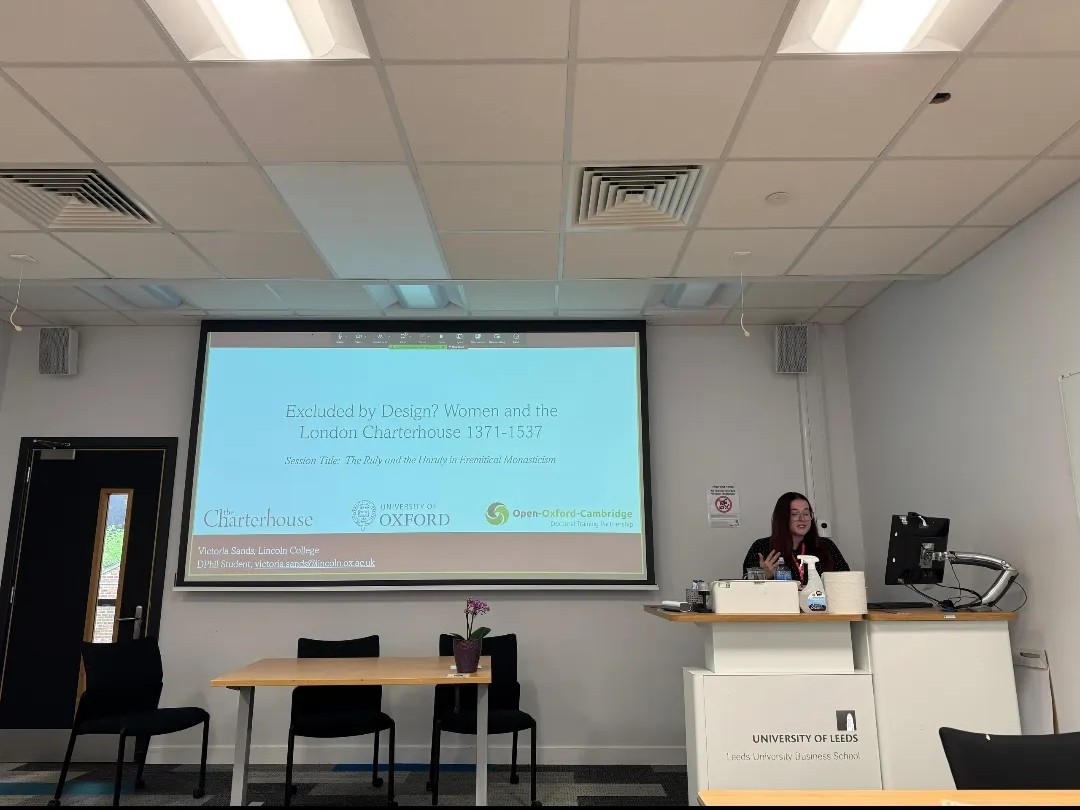
Presenting my paper on the London Charterhouse
I gave my paper – ‘Excluded by Design?: Women at the London Charterhouse 1371- 1537’– on the Monday afternoon. It considered how women were both included and excluded in Carthusian’s prescriptive literature, but argued that, even where excluded, this was not necessarily upheld in practice. I drew together ideas and examples from the first three chapters of my research and used the London Charterhouse as a case study for how rules and practice had an interesting, symbiotic relationship. For example, items might find their way into the rules because they are perceived as necessary and doable for the population – such as banning women. However, if these rules are repeated over and over again in later editions of customs, then this gives an indication that this rule may in reality have not been followed, which is why the leaders felt the need to reiterate it.
Two other papers were also presented, one on hermits and personal hygiene, and one on Carthusian apologetic literature. These were different but complementary to my topic, and I found it so interesting to hear about other Carthusian research. We took questions from the audience and were met with thought-provoking ideas. I received a number of helpful questions on different areas of my project such as patronage, burials and connections with other monasteries, and it gave me lots to follow up on. Even after this, I was approached at various points throughout the rest of the week by interested parties. Everyone was so supportive, and it was a lovely environment to present in.
After presenting on the first full day of the conference, I then attended many panels over the following days. The papers I listened to tended to focus on either gender or monasticism, though I did try to branch out into other topics. Sometimes a completely unrelated talk can spark a completed unexpected idea, so it is always worth trying out new things when you can. There were hundreds of talks that I would have liked to attend, so I had to make some difficult choices. Luckily though, the conference was filmed, and the online recordings are available for attendees.
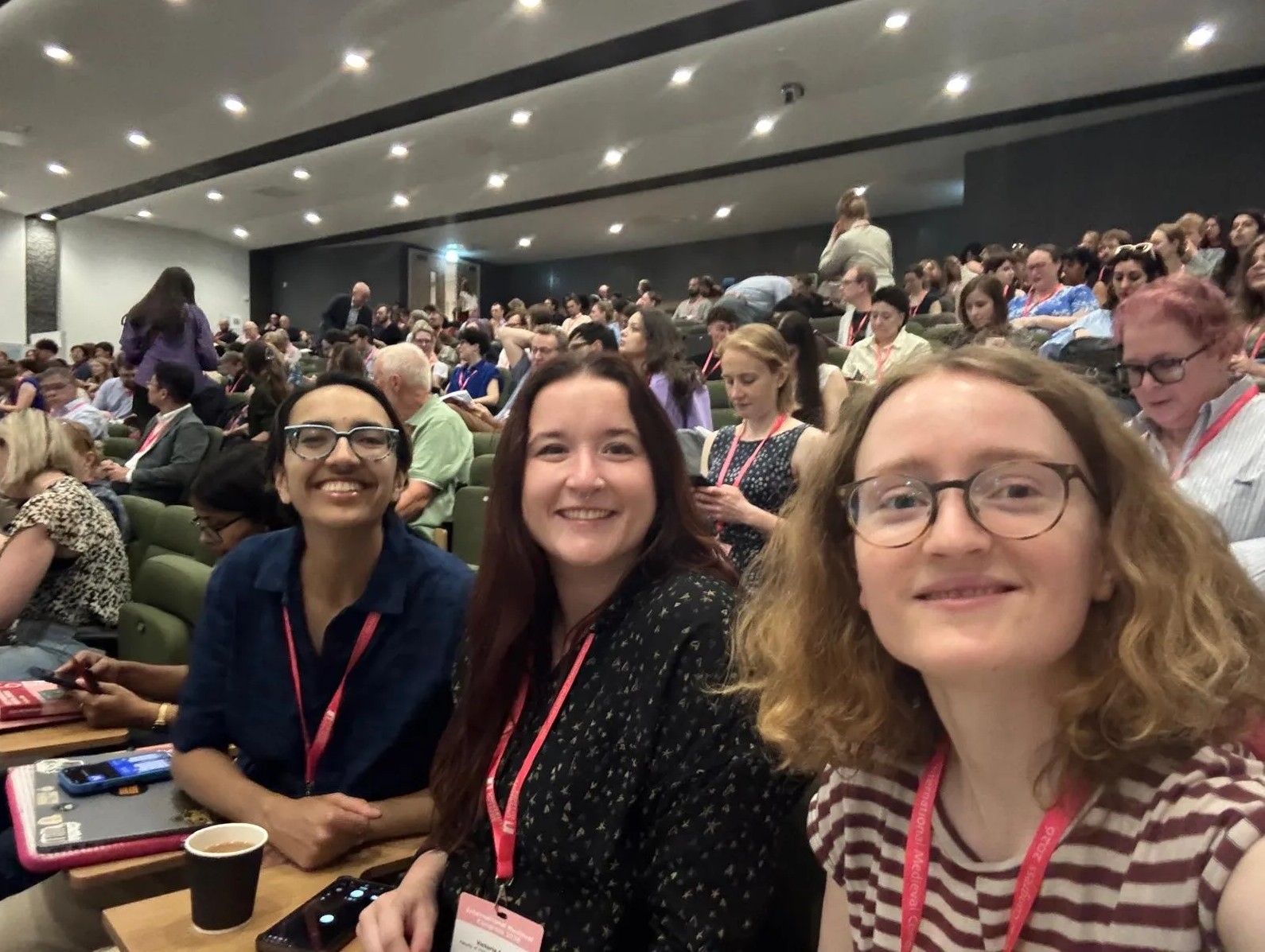
With my colleagues Hannah and Rebecca in the lecture hall
In between morning, afternoon and evening sessions many conversations and introductions were had over a coffee in the café. Additionally, the evenings were spent at networking dinners, where I spoke to the most interesting colleagues about their research and more. Receptions and keynote lectures offered further opportunities to meet with different groups of academics. I also managed to attend a few workshops, the book fair, and peruse the stalls of trinkets, but had to head back to Oxford on the Thursday.
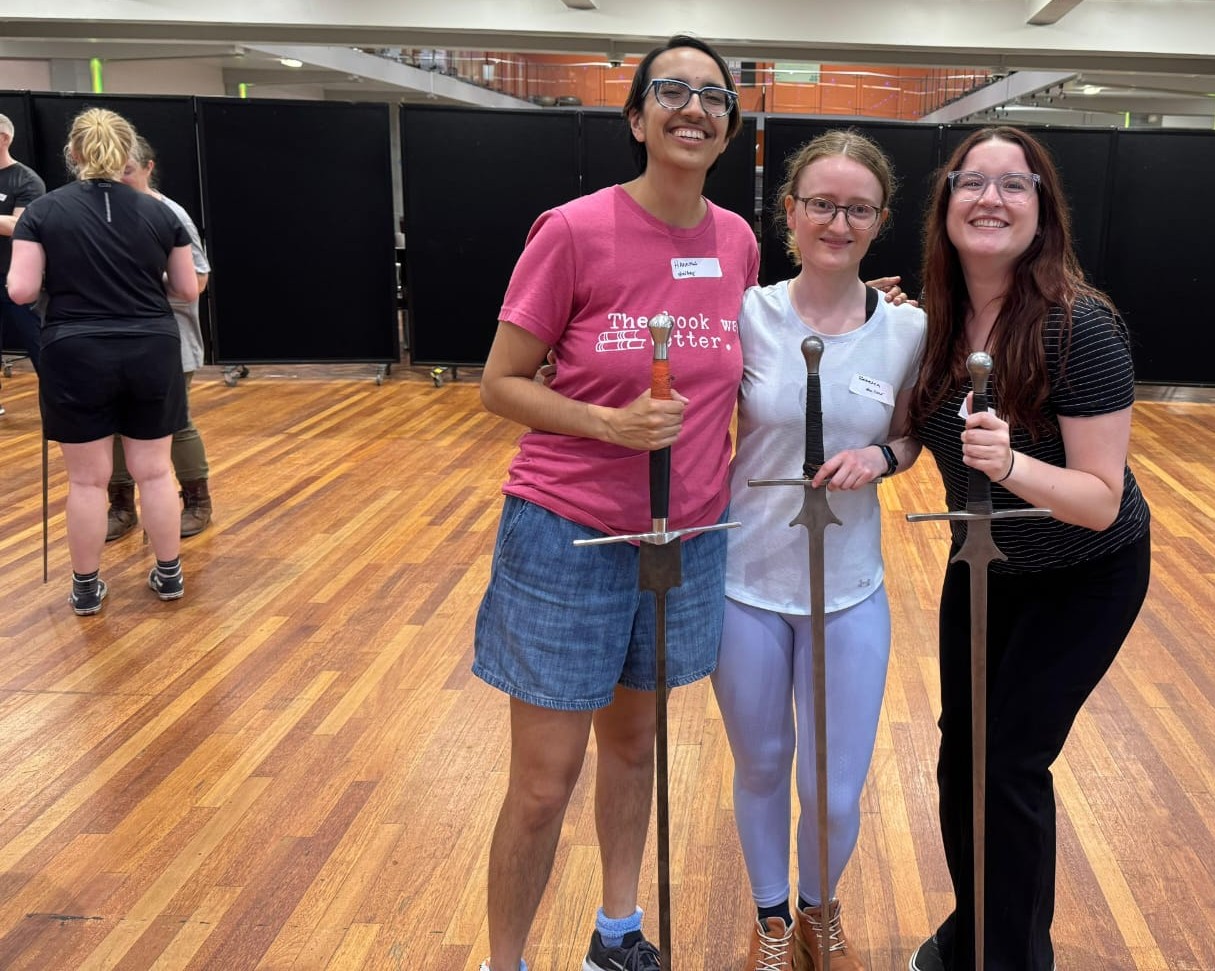
At a longsword workshop
I thought that I would be thoroughly exhausted by the end of the conference, but I left disappointed that we can’t have an IMC every week! The conference was invigorating for my research, and I headed home with so many new strands of research to pursue, and connections that I hope to keep in touch with.
As well as it being an excellent week, this conference was a fantastic opportunity to tell people more about the London Charterhouse. I don’t think I have ever talked so much about the site or the Carthusians in general! But, what an amazing opportunity, and I feel lucky that I had the chance to attend.
Next year’s IMC will focus on ‘Communities’ with its call for papers already out. I am looking forward to it already!
Written by Victoria Sands
With thanks: Many thanks to the Open-Oxford-Cambridge AHRC Doctoral Training Partnership for funding me to attend this conference, to Tom Gaens and Stephen Molvarec for inviting me to speak on the Carthusian panel and more generally for their help with my project, and to the other speakers, our moderator, and sponsors of the panel.
Victoria is a second-year D.Phil. candidate in History and has a keen interest in women’s history particularly pre-1700 and built heritage. She is studying at the University of Oxford and carrying out research in partnership with the Charterhouse. The focus of her research is illuminating the hidden lives of women associated with the Charterhouse in the medieval and early modern periods. The project is generously funded by the Open-Oxford-Cambridge Doctoral Training Partnership and the Clarendon Fund.