

There are many medieval charterhouses that still exist today beyond the UK in varying tangible forms, and around twenty of these can be found in Germany. This May, I was invited to visit two of these wonderful sites, and to present my research on the London Charterhouse at a Charterhouse Workshop.
My hosts were the Metropolis Project team at the Kartäuser in Nürnberg (“Kartäuse” being the German word for Charterhouse). As a team, they are seeking to better understand the individuals who lived at the medieval Nürnberg Charterhouse. They are studying the history of the Carthusian Order and the physical layout of the site to produce a detailed collective biography of those associated with it, uncovering the patterns and relationships between them.
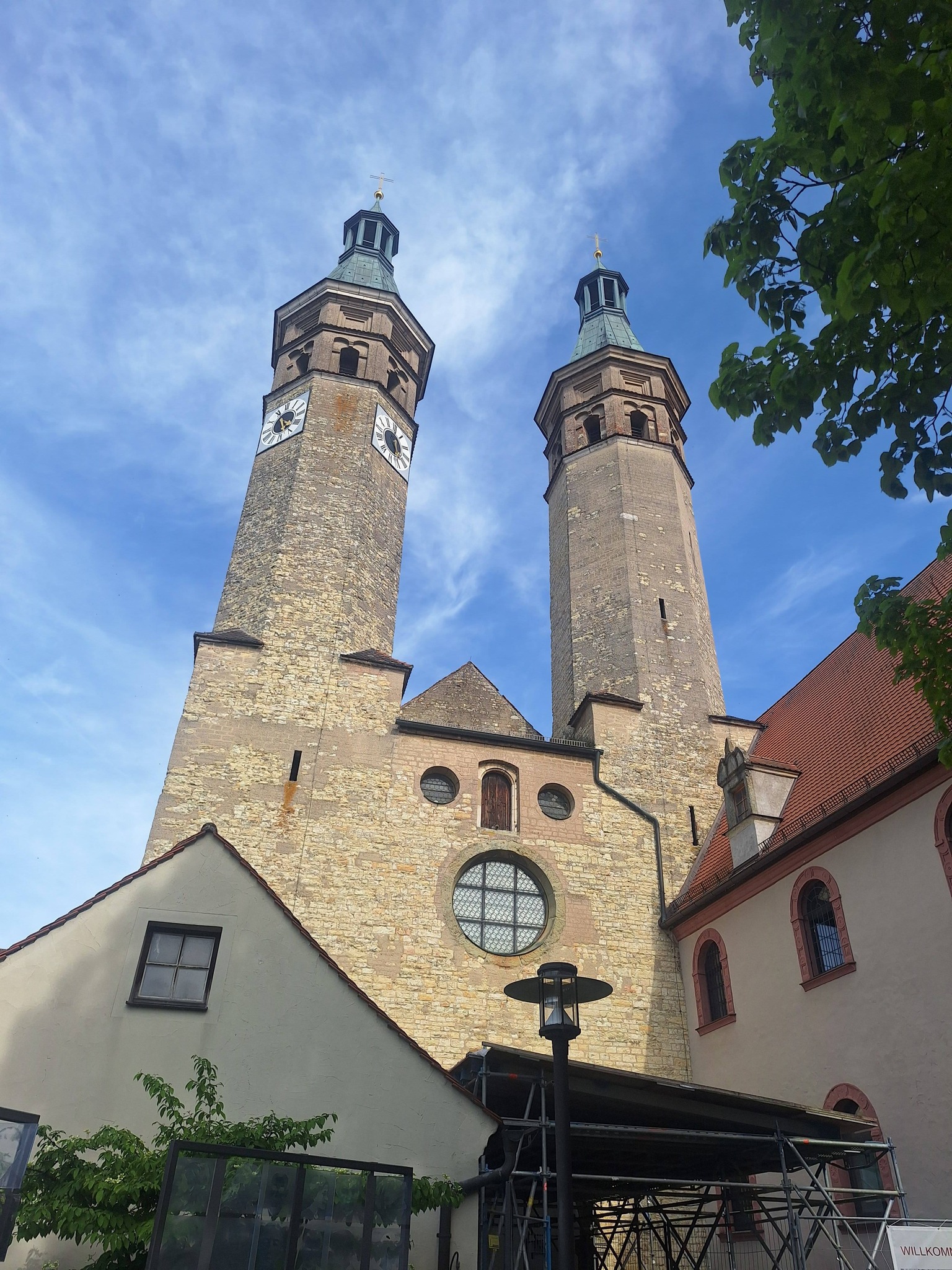
Prüll Charterhouse, Regensburg
The first stop of my visit, only a few hours after my arrival, was the Prüll Charterhouse in Regensburg, where the Metropolis Project research team and I were given a wonderful tour by Lissy Höller. The site was originally founded as a Benedictine Abbey in 997 by the Bishop of Regensburg. It remained as such until 1484, when, with the support of the Duke of Bavaria, it became a Carthusian monastery and was adapted to suit the Order. Around 300 years later, the monastery was dissolved in 1803 during the secularisation of the region.
What was most exciting was that a complete medieval Carthusian cell can still be seen within the Prüll Charterhouse. Unlike the cell at the London Charterhouse, which only includes the surviving doorway, the cell at Prüll is fully intact and can be entered. Inside, you can appreciate the true size of a monk’s living quarters and their private garden, which was incredibly helpful for understanding more about the London house and the monks’ daily lives more generally.
A psychiatric institution was based there from 1852, and today the monastic remains share the site with the city’s contemporary psychiatric hospital, the Regensburg District Clinic (Bezirksklinikum Regensburg).
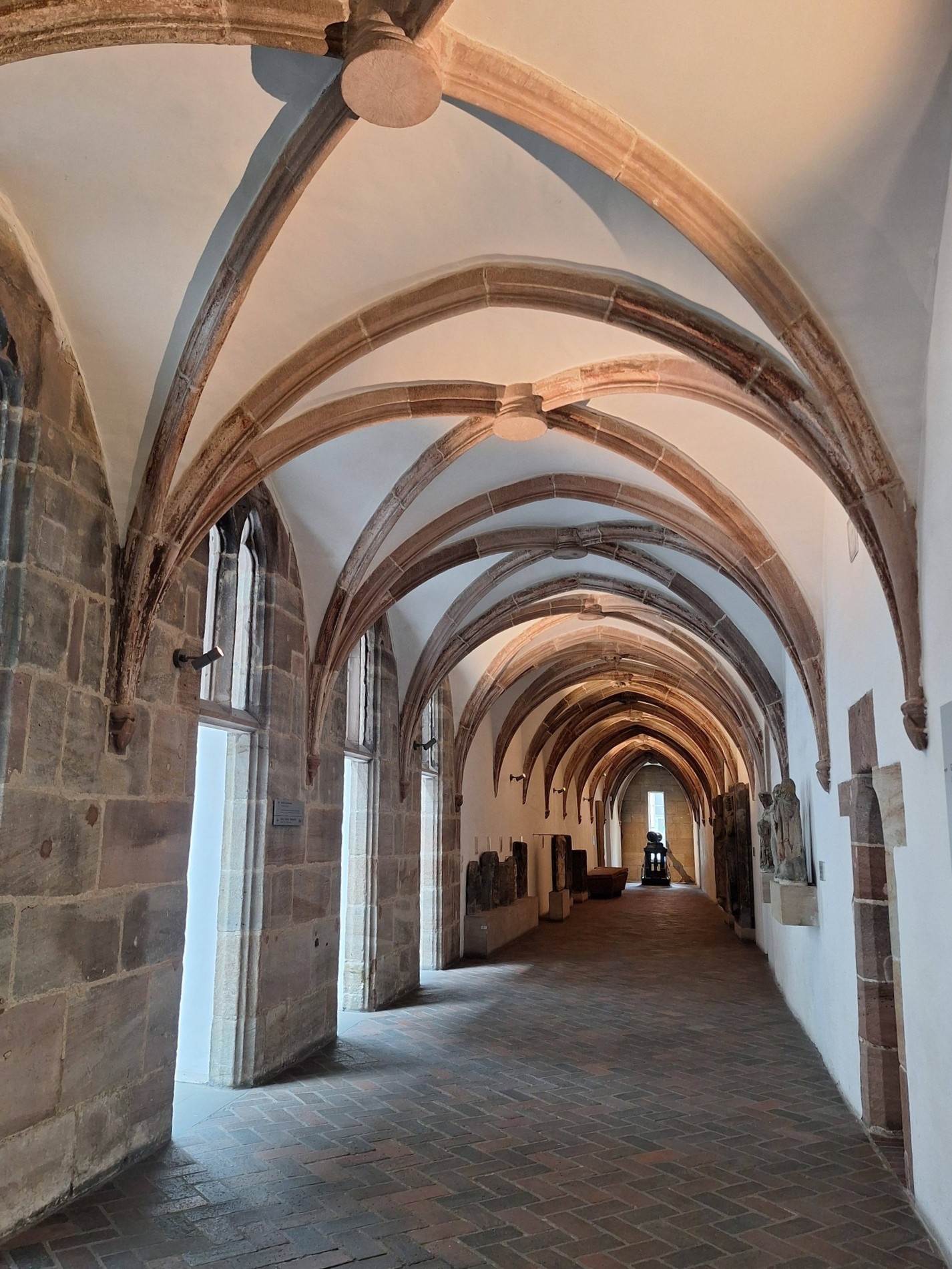
Marienzelle Charterhouse, Nürnberg
On the second day of my trip, we headed to Nürnberg on the train and visited the Marienzelle Charterhouse. Since 1857, the remaining medieval architecture of the charterhouse has been cared for by the Germanisches Nationalmuseum. Alongside Mount Grace in England, the Nürnberg Charterhouse represents one of the best-preserved purely medieval monastery buildings of the Carthusian Order.
The charterhouse itself was founded as a Carthusian monastery in 1380 (only a few years after the London Charterhouse) by the Nürnberg merchant Marquard Mendel. Similar to the London house, the founder of the Nürnberg house was buried on site when he died in 1385. The construction of the buildings continued until the middle of the 15th century.
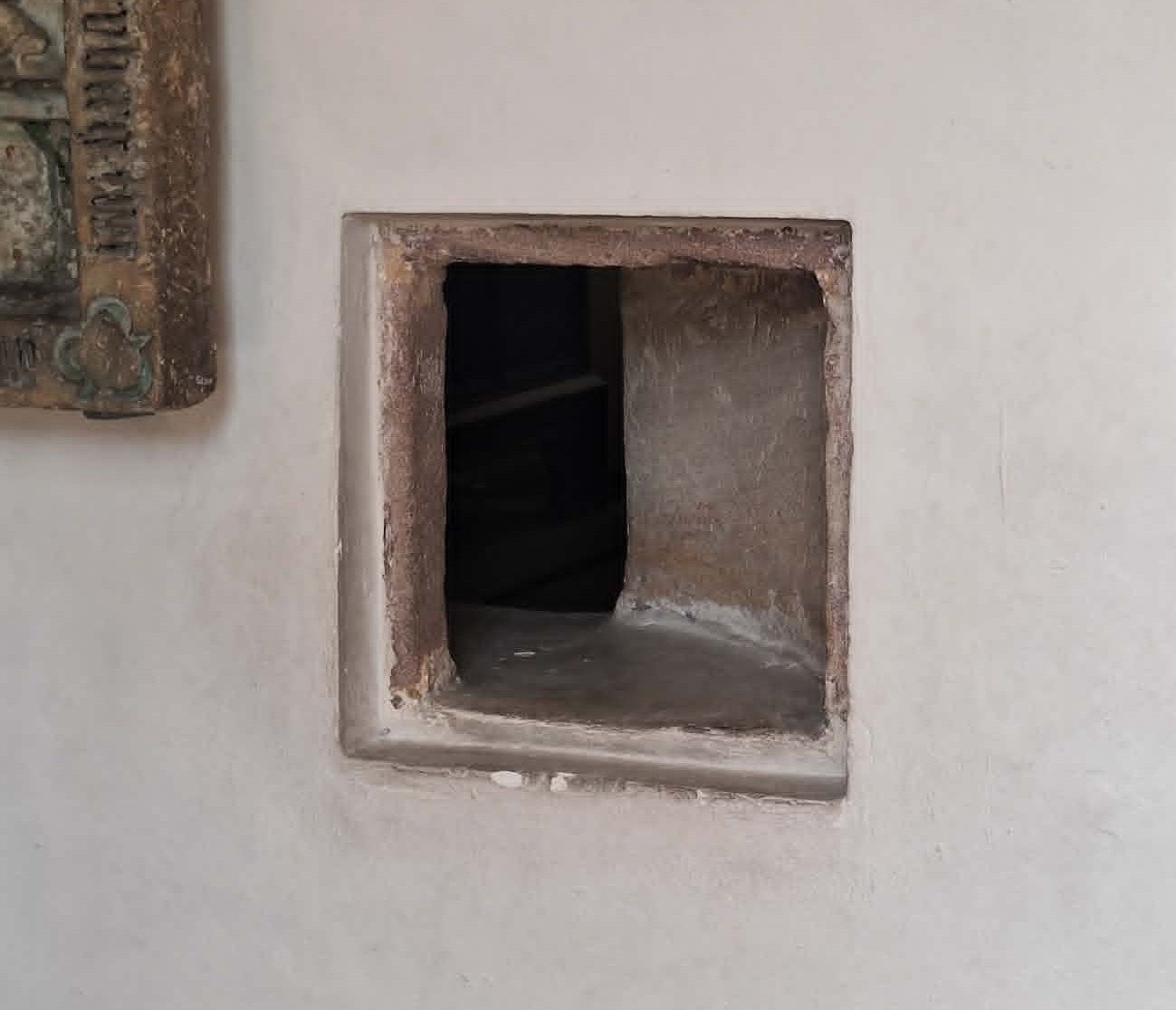
Today, the vaulted cloister still remains. I was fascinated by the ceiling in particular, as the London house’s surviving cloister walk is covered by a ceiling that was a later 16th-century addition. Marienzelle also has monks’ cells which include surviving serving hatches. As there is a serving hatch next to the cell door in the Charterhouse in London, I was keen to compare them! Interestingly, the hatch in Marienzelle was a slightly different shape to the one in London: Nürnberg’s hatch was slightly curved between its exterior opening and the cell, whereas London’s hatch sits at a sharp 90-degree angle.
The Marienzelle Charterhouse was dissolved in 1525 during the German Reformation. It is one of only a few monasteries in this region that closed because so many of its monks actively chose to follow the teachings of Martin Luther.
After this, the site was used partly as private housing for widows in need, and the church was used as a gunpowder storehouse. The site eventually returned to religious use in 1615 as a Protestant Church.
Despite being around 1,000km apart, the London and Nürnberg houses share a remarkably similar chronology. Both founded in the late 14th century, they reflect a specific phase of construction for urban Carthusian houses. Both houses were dissolved during the reformations that took place in their respective regions – with Germany’s closure in 1525 happening slightly earlier than the final closure of the London house in 1538. They both found secular uses as private housing after the Reformation, and also as storage facilities (Nürnberg for gunpowder, and London for Henry VIII’s tents). Finally, both returned to a religious or charitable use: Marienzelle became a Protestant church, while London became an almshouse and school where the Protestant Chapel was fundamental to its function.
Charterhouse Workshop
Central to my trip was a Charterhouse Workshop, where I listened to presentations from members of the Metropolis Project and presented my latest research on the London Charterhouse. As we developed our discussions, we uncovered some fascinating similarities between the sites, such as the tightly-knit networks between the founders of different charterhouses.
There were, of course, some variations between England and Germany. The German Reformation was earlier than the English and did not result in the sweeping dissolution of all monasteries. This is because the Holy Roman Empire was made up of hundreds of semi-autonomous regions, and each ruler could decide whether they wanted to resist or implement Protestant reforms. Bavaria, for example, remained largely Catholic, meaning the charterhouse in Regensburg survived throughout the Reformation period.
What this workshop, and the trip more widely, identified is that collaboration across national lines is really helpful. The Carthusian Order was of course not only active in England; many more houses can be found across Europe, and lots of them are still standing today. If I only compare the London house with other houses in England, I miss a wealth of vital information and points of comparison. Considering the locations of other urban houses, such as Nürnberg, will no doubt be incredibly helpful for better understanding the London Charterhouse. This trip was exceedingly helpful for widening my thinking and will continue to influence my DPhil research moving forward.
Written by Victoria Sands
Thanks
I am deeply thankful to Prof. Dr. Jörg Oberste who organised the trip, and to Sophia Wagner, Isabell Alexa Hesse, and Jasmin Rother-Struck who took me around the cities. Also to Dr Angelika Hofmann at the GNM for her tour of the Marienzelle Charterhouse and presentation, and to the anthropologists Prof. Dr. Jörg Orschiedt and Hellen Mager for their involvement with the workshop. I am also thankful to Lincoln College, Oxford and the Universität Regensburg who funded this trip.
Victoria is a second-year D.Phil. candidate in History and has a keen interest in women’s history particularly pre-1700 and built heritage. She is studying at the University of Oxford and carrying out research in partnership with the Charterhouse. The focus of her research is illuminating the hidden lives of women associated with the Charterhouse in the medieval and early modern periods. The project is generously funded by the Open-Oxford-Cambridge Doctoral Training Partnership and the Clarendon Fund.
Aditional info:
Kartäuser in Nürnberg Project Website: Kartäuser in Nürnberg | GNM
Breeden, F. (2018) Communal Solitude: The Archaeology of the Carthusian Houses of Great Britain and Ireland, 1178-1569. PhD thesis, University of Sheffield.
Hofmann, A. and Linck, R., (2023) Auf Spurensuche im Nürnberger Kartäuserkloster: Bodenradar im mittelalterlichen Kern des Germanischen Nationalmuseums. Acta Praehistorica et Archaeologica, 55, pp.121-132.
For more information on the English charterhouses, see previous blog article: Medieval Charterhouses in England – The Charterhouse.